7 Easy Ways to Chew Your Food More (Without Forcing It)
Knowing you should chew more is easy — actually doing it isn't. Here are 7 practical tricks that make chewing more happen naturally, starting at your next meal.
You know you should chew more — but the moment you start eating, you forget. That’s normal. Instead of relying on willpower, the trick is to set up situations where chewing more happens on its own. Here are seven you can try today.
1. Put your utensils down between bites
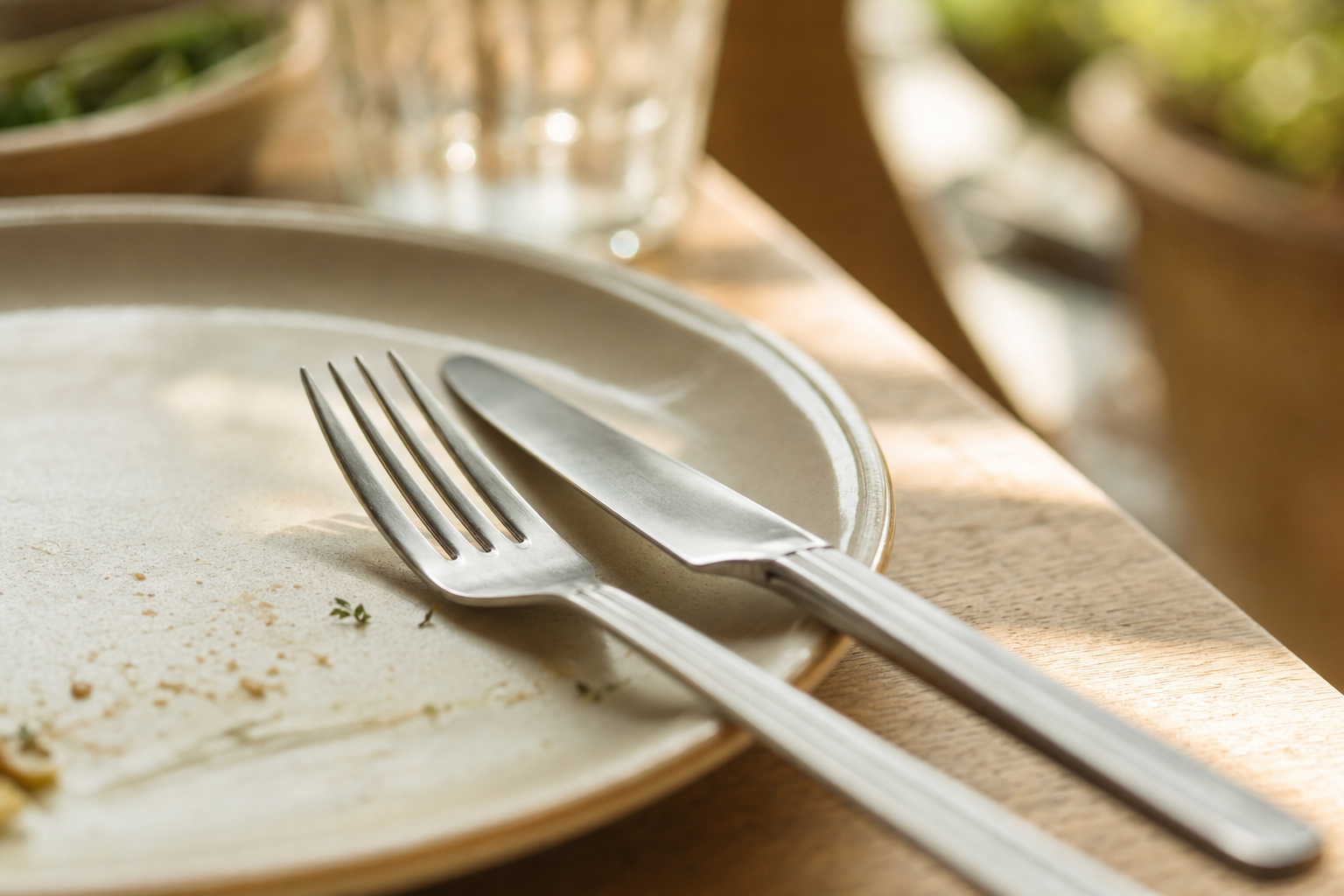
If the next bite isn’t immediately in hand, you naturally chew longer. This is the single highest-impact habit.
2. Take smaller bites
Big mouthfuls tend to get swallowed before they’re well chewed. Smaller bites raise your chew count automatically.
3. Choose foods with more texture
Root vegetables, mushrooms, seaweed, nuts, whole grains. Even just cutting food into slightly larger pieces means more chewing.
4. Try eating with your non-dominant hand
It slows your pace and brings attention back to the meal. Even doing it occasionally helps.
5. Stop eating while distracted
Eating in front of a phone or TV dulls your sense of chewing and speeds you up. Try putting the screen away for at least the first few bites.
6. Don’t wash food down with drinks
Rinsing food down with water or tea cuts chewing short. Drink after you’ve swallowed.
7. Focus on just the first three bites
Trying to be perfect for a whole meal won’t last. Deciding “I’ll chew the first three bites slowly” is enough to set the pace for the rest.
For how many chews to aim for, see how many times should you chew; for the benefits behind it, the benefits of chewing; and for a broader approach, mindful eating.
You don’t need to do all seven. Start with #1 and #7 — put your utensils down, and mind the first three bites. That alone makes a difference.
Sources
- Harvard Health Publishing — 8 steps to mindful eating
- Miquel-Kergoat S, et al. “Effects of chewing on appetite, food intake and gut hormones: a systematic review and meta-analysis.” Physiol Behav. 2015. PubMed